Partnership Model as the Path Into America
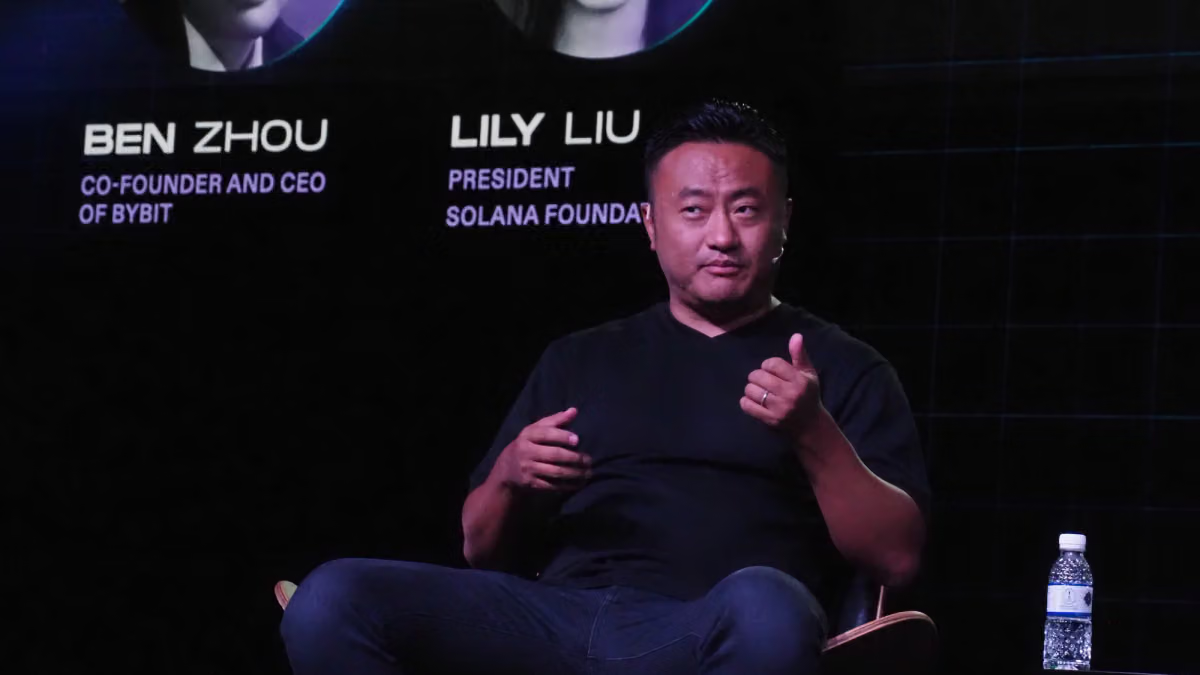
Bybit, which currently ranks as the second-largest cryptocurrency exchange globally by trading volume, has signalled that its entry into the United States will hinge on forging a relationship with an established brokerage firm rather than building a standalone operation from scratch. CEO Ben Zhou confirmed in a recent interview that the exchange intends to team up with a local company that already commands a significant retail and institutional client base in the country, positioning Bybit to compete directly with platforms such as Robinhood Markets (HOOD, trading at $101.93 at the close).
Zhou described the partnership approach as Bybit's default playbook whenever it expands into a new jurisdiction. He specifically cited Interactive Brokers (IB) as an example of the type of firm he would consider, characterising the ideal partner as one that "wants to enter the crypto field and… already has a client base in the U.S." He added that any brokerage with a solid domestic footprint that has not yet moved into digital assets would fit the bill.
The exchange reports more than 80 million registered users spread across 180-plus countries and regions, and it has been steadily accumulating regulatory licences worldwide in preparation for a broader slate of regulated products. In Europe, Bybit is planning to launch what it calls an "everything app" bundling derivatives trading and tokenised equities, with a target rollout as early as the first quarter of next year.
Sidestepping the State-by-State Licensing Quagmire
For traders and institutional clients tracking how new platforms gain U.S. access, the strategic choice matters. Bybit's partnership route deliberately avoids the costly, multi-year grinding process that competitors like Coinbase Global (COIN, $177.07 at the close) have undertaken — collecting money-transmitter licences state by state and ultimately pursuing the heavily regulated New York Bit License.
Zhou put the timeline for that state-by-state route at two to three years and questioned whether the effort is even worth the investment. He suggested he would rather wait for the pending Clarity Act to clear congressional hurdles, or for a potential regulatory consolidation in which the SEC assumes a single federal oversight role, meaning one licence would cover the entire country. "I might as well just wait for the Clarity Act to pass or have a better understanding of what the new law is," he said, adding that a unified federal framework would simplify market entry considerably.
A Clean Record and the Case for Patience
One of the more striking points in Zhou's remarks was his framing of Bybit's absence from the U.S. market as a strategic asset rather than a competitive gap. Because the exchange has never launched an American operation, it carries what he described as a "completely clear record" in the jurisdiction — no prior regulatory disputes, no compliance history to untangle.
"Bybit is the only one that's been sitting out of the U.S., and as a result we have a completely clear record there," Zhou said. He stressed that the company can move in "any time if the moment is right" and that he intends to leverage that clean slate rather than rush into the market out of what he termed FOMO — the fear of missing out that can push firms into poorly timed, costly expansions.
He acknowledged that the American market, while enormous, is also intensely saturated. The entrenched position of Coinbase and the rapidly expanding footprint of Robinhood make it one of the most competitive trading environments in the world. Zhou noted that even regions such as Southeast Asia, Latin America, and Africa are seeing increasing rivalry among exchanges.
The U.K. and Europe as Near-Term Growth Pockets
Amid the U.S. wait-and-see posture, Zhou pointed to the United Kingdom as a market he considers "pretty good" and relatively untapped. He highlighted that London is in the process of finalising a new regulatory regime for digital assets and that no single global exchange has established dominance there yet, with Coinbase being the most prominent foreign player.
"The U.K. is looking towards a new regime for crypto, and none of the global exchanges are dominant there," Zhou said. He cautioned, however, that the cost of entry would be substantial — comparable to the effort required to obtain a MiCA licence in the European Union — but confirmed that Bybit is actively evaluating the opportunity.
Earlier in the year, Zhou was invited to sit down with government-linked bodies, including the Financial Conduct Authority (FCA) and members of the House of Lords, the upper chamber of the British Parliament, underscoring the depth of Bybit's engagement with UK policymakers.
When asked whether Bybit already operates a London office, Zhou responded: "We're looking, but we haven't decided where yet." The exchange is thus in the early stages of establishing a physical European headquarters, a move that would signal a more permanent commitment to the UK and broader European markets.