A New Hedging Instrument for a Market Long Dependent on Spot Pricing
CME Group is preparing to list the world's first tungsten futures contract, a move designed to give miners, manufacturers, and trading desks a structured way to manage price risk in a market that has historically relied almost entirely on spot quotations. The new instrument, expected to begin trading in the first quarter of 2027 pending regulatory approval, will be cash-settled against Fastmarkets' Western benchmark for ammonium paratungstate (APT) — the raw material and commercial precursor used in virtually every downstream tungsten product.
For brokers and their institutional clients, the introduction of an exchange-traded forward curve represents a structural shift. Where the tungsten market has previously offered little visibility beyond the current spot price, a liquid futures ladder will allow participants to see how the market is pricing supply constraints months and even years ahead. That forward-looking information is particularly valuable for desks managing industrial client exposure, as it creates a transparent reference point for hedging strategies that were previously difficult to execute in a thinly traded physical market.
Jin Hennig, managing director and global head of metals at CME Group, framed the launch in terms of converging forces — advanced manufacturing, semiconductor technology, and geopolitics — all of which are driving clients to seek better price transparency and more effective risk management. He noted that the tungsten contract will slot into CME's expanding lineup of critical-minerals and energy-transition metal products, giving participants additional tools as global supply chains undergo a fundamental restructuring.
Fastmarkets CEO Raju Daswani echoed the sentiment, observing that rising volatility and the concentration of supply in a small number of countries are making transparent, trusted price benchmarks more essential than ever. He described the new contract as a meaningful step in connecting physical-market price discovery with practical risk-management opportunities.
Geopolitical Shockwaves Reshape Tungsten Supply Dynamics
The timing of the CME announcement is not accidental. In early 2025, Beijing imposed restrictions on the export of tungsten to Western defense and industrial buyers, triggering a sharp spike in Fastmarkets' Western APT benchmark. Prices climbed as high as $3,000 per metric tonne before easing to roughly $2,775 in subsequent months. That episode underscored how quickly a single policy shift can disrupt a market that had long operated with relatively stable, China-dominated supply flows.
The broader context is one of intensifying resource nationalism and a global rearmament cycle that is pulling tungsten demand — used in everything from drill bits to missile components — sharply higher. Western governments are accelerating efforts to secure conflict-free access to critical materials, and the absence of a standardized hedging mechanism has been a persistent gap in that strategy. The CME contract aims to close that gap.
A Financial Times report published around the same period reinforced the urgency, suggesting that spot prices for critical materials remain disconnected from underlying scarcity. In that piece, Japan was described as being just "months" away from exhausting its stockpiles of critical rare earths, a warning that the supply-pressure wave is far from limited to tungsten.
Almonty Industries Pitches Itself as the West's Tungsten Lifeline
The CME announcement coincided with Almonty Industries' Investor Day, held at Nasdaq in Midtown Manhattan. The tungsten producer presented to analysts from Oppenheimer, Stifel, Jefferies, Goldman Sachs, and other firms, with CEO Lewis Black and his management team walking through the company's operating outlook across its South Korean, Spanish, and Portuguese mining assets.
Almonty's core investment thesis is its positioning as one of the largest conflict-free tungsten producers outside China, making it a critical supply node for Western defence and industrial customers. Black told investors that the tightening of Western tungsten availability is strengthening the company's commercial leverage, translating into improved offtake terms as its Sangdong mine in South Korea ramps up Phase 1 output and progresses toward Phase 2 expansion.
Sangdong's Phase I is engineered to process 640,000 tonnes of ore per year. Phase II is designed to double that throughput, and the company confirmed that equipment orders have been placed and underground planning is already under way. Additional expansion projects and supplementary supply sources were also outlined as part of the growth pipeline.
Analysts See a Structural Deficit and Widening Premiums Ahead
Reaction from sell-side analysts was broadly constructive. Stifel's Brock Cannon, a materials specialist, reiterated a Buy rating and raised his target price to $21. He noted that Almonty's production ramp is still unfolding while prices sit just below record highs, and he characterised the company as a key solution to meeting Western tungsten demand in the wake of China's market exit. He did flag that the push-out of Sangdong shipments is a timing consideration.
Jefferies' Laurence Alexander, covering chemicals and materials, pointed to the Sangdong ramp as a near-term catalyst for the stock. He highlighted the early-January U.S. rule that bars defence contractors from sourcing tungsten, tungsten metal powder, or tungsten heavy alloys if the material was mined, refined, or produced in China, Russia, Iran, or North Korea. Alexander called the ban a clear pivot point in demand that should dovetail with the production ramp. He also stressed that only about 13 percent of global tungsten production currently comes from conflict-free zones, meaning the qualified supply pool is likely smaller than headline deficit figures suggest. Should the European Union introduce a comparable measure, he warned, Western premiums would likely widen further.
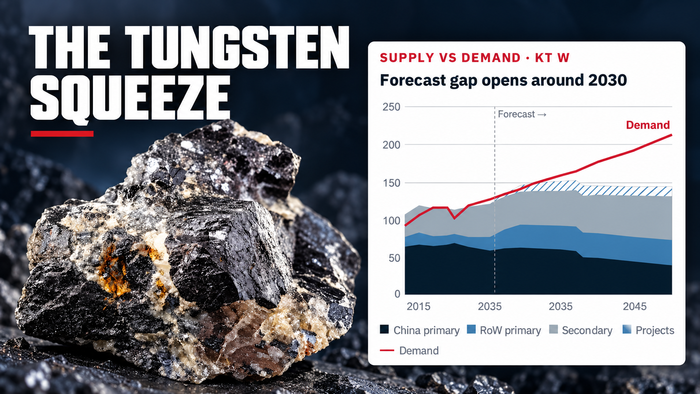
The Almonty investor deck included a chart that drew particular attention: a widening structural tungsten deficit projected to emerge around 2030, driven by the convergence of rising defence and industrial demand against constrained non-Chinese supply. For brokerages and their clients, the practical implication is clear — the CME futures curve, once live, will be the first instrument that lets the market price that 2030 shortfall in real time, and the mining and trading companies that own the bottlenecks stand to benefit most as the rearmament cycle accelerates.