CMC Markets Opens CFD Accounts to ChatGPT Queries
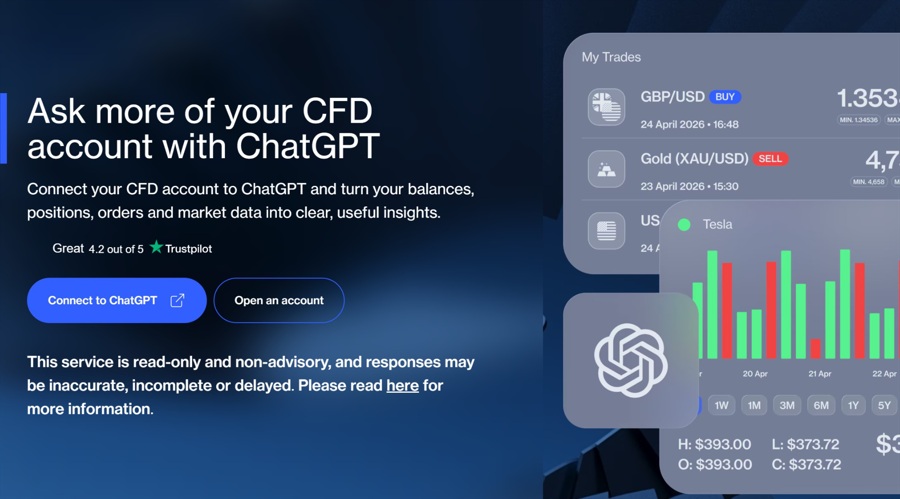
CMC Markets announced on Thursday that clients in the United Kingdom can now link their contract-for-difference (CFD) accounts to OpenAI's ChatGPT, enabling them to ask about account balances, open positions, pending orders and current prices in natural language. The connection is strictly read-only: the chatbot has no ability to open, amend or close a position, nor to transfer funds between accounts.
The service is limited to CFD accounts at this stage. Spread betting accounts remain unsupported, and in markets where real-time pricing is not available the tool will return quotes delayed by 15 minutes, as noted on the broker's product page. The launch announcement included example prompts, such as requesting a summary of total account value, checking the status of pending orders, or pulling up a three-month daily candlestick chart for Apple shares.
CMC framed the integration as one element of its broader investment in AI and technology infrastructure. In November of last year the firm outlined a three-phase roadmap for building a "super app" experience for retail clients. Ross Gustafson, head of cloud at CMC Markets, described the ChatGPT link as providing "a strong foundation for developing richer, more intelligent client experiences over time."
A Rapidly Expanding Field of AI-Powered Brokerage Tools
The CMC launch positions the UK-based broker at the conservative end of what has become a fast-moving sector. FM Intelligence tracked at least ten brokers and platform vendors that embedded AI agents into live client accounts during the first half of 2026, several of which permit the agent to draft or dispatch trading orders.
The closest comparable offering is IG's Australian operation, which in May placed a read-only CFD assistant into ChatGPT's app store for local clients. Beyond prices, positions and orders, that assistant also surfaces client sentiment data, saved watchlists and full transaction history.
Interactive Brokers has pushed one step further. It connected Anthropic's Claude in June, subsequently added ChatGPT and xAI's Grok later that same month, and in July opened its connector to any application built on the Model Context Protocol (MCP). Even so, the client retains final authority: every AI-drafted instruction must be manually converted into a live order before execution.
Spotware went further still in May, when its cTrader AI Agent Connect allowed external AI tools to place trades and manage positions directly by prompt. ThinkMarkets followed in June with an MCP server that lets AI assistants execute trades while blocking any access to client funds. Leverate, whose MCP for Traders module was released just last week, transmits orders from ChatGPT or Claude once the trader explicitly approves them.
Notably, CMC's integration is exclusive to ChatGPT. FM Intelligence's tally found that Anthropic's Claude was named in nine of the ten tracked launches in the first half of the year, while ChatGPT appeared in five — a signal that the AI-assistant market is not yet dominated by a single platform.
Regulatory Gaps and Risk Warnings for Traders
For traders considering these new AI channels, the regulatory picture remains unsettled. The UK's Financial Conduct Authority (FCA) has not yet issued specific rules governing how AI agents may interact with client accounts. A review published in July, led by executive director Sheldon Mills, examined how AI is expected to reshape retail financial services by 2030. The paper proposed that existing frameworks — the Consumer Duty and the Senior Managers Regime — could be extended to cover AI-driven interactions, but dedicated rulemaking has not followed.
CMC's own product page carries explicit caveats. It warns that ChatGPT responses may be inaccurate or delayed, and states clearly that the tool does not constitute regulated financial advice. Clients are instructed to verify all prices, positions and margin levels directly on the CMC platform before acting on any information surfaced through the chatbot.
For traders in the UK and beyond, the practical takeaway is a widening menu of AI-assisted access to brokerage data — but with important distinctions in how far each broker has allowed the technology to go, and with regulatory guardrails still catching up to the pace of deployment.